
SFB16 Draft Review: The All-Tight End Masterpiece Is Complete
Jake Trowbridge relives his SFB16 draft, where a bit was born out of friendship and generosity.
What’s your strategy at tight end in drafts this year? Think you’ll go early, grabbing one of the few elite guys in the first couple of rounds? Or do you plan to scoop up one of those fellas in the middle of the draft? Or will you wait until the bitter end to take a couple stabs at high upside dart throws?
Well … what if you did all of the above?
I did.
No really. I drafted a tight end in every single round of my most recent draft. 20 tight ends in total. And I feel great about it …

Join Our Newsletter
Trusted by 400,000+ fantasy football players. Get access to Fantasy Life's free award winning newsletter and tools, all in one step.
By registering or logging in, you agree to our Terms of Use and Privacy Policy.
Scott Fish Bowl 16 (SFB16) Draft Review
I Did WHAT???
I should give a little context. The Scott Fish Bowl is a massive annual fantasy football tournament that raises money for charity. Thousands of people worldwide compete every year. Fantasy analysts, celebrities, and other folks who just love fantasy football are split into equal divisions, some drafting at live events and others drafting online (probably pants-less) from the comfort of their homes.
Winning a league with 5,000+ participants isn’t easy. Especially when the tournament is notorious for featuring some truly batsh*t scoring settings. And I mean that in the best way.
This year the scoring includes big-play bonuses (10 points for every 20+ yard reception or 40+ yard rush/pass) and big-game bonuses (10 points for 100+ yard rushing/receiving games or 300+ yard passing games). Oh, and there are pretty much no positional requirements. You can’t start more than two QBs, but otherwise the lineup is yours to do as you wish. Your only limitation is your imagination.
Winning a tournament like this doesn’t happen by playing it safe. To emerge victorious requires some creativity.
So when I walked into the Madison, Wisconsin live draft, I had no game plan. But I was ready to be a wild card. See, this is my seventh year participating in the Scott Fish Bowl, and in that time I’ve learned a couple of things (and only a couple of things):
- The draft never goes how you think it will.
- You’re never going to win the whole thing drafting like everybody else.
And that’s why, at the end of 20 rounds, I had 20 tight ends on my roster. No quarterbacks. No running backs. Not one damn wide receiver.
And I understand if your first thought upon reading that is “You are a dumb stupid idiot, and you deserve endless diarrhea for doing something so moronic.” Which … harsh! But fair.
But did I mention that tight ends also get an extra point per reception and an extra point per first down in this format? So there’s a chance that an all-TE build is just crazy enough to actually work …
It’s Just Good Strategy
My first pick was an easy decision. Puka Nacua, Ja‘Marr Chase and Bijan Robinson went off the board first. Picking at 1.04, there was an obvious choice staring me in the face: Brock Bowers.
He’s ideal for this scoring format. In his rookie season, Bowers put up the second-most 20+ yard catches for a tight end, behind only George Kittle. He also had the second-most first downs, behind Trey McBride. If he’d stayed healthy last year, I think he could’ve topped himself in both categories.
Not only that, but the theme of this year’s tournament is video games. And if you rearrange the letters in Brock’s last name, you get “Bowser.” As in Mario’s nemesis. Big dragon turtle-looking guy? Lots of spikes? Penchant for kidnapping? Anyways, you can see how the decision was practically made for me.
When I was on the clock in the second round, I couldn’t believe my luck that Colston Loveland was still available. I’ve spent much of the offseason dumping on the Bears, particularly Caleb Williams, because I expect significant regression. Loveland, however, has the talent to stand above it and is the only piece on that team I actually trust. The boos and jeers from my fellow drafters told me that sticking his name up on the big board was the right call.
But coming back around in the third round, I had a tough decision to make. There were several quality non-TE options available, including the ultra-reliable Chase Brown and Emeka Egbuka, whom I’ve hyped up so much that I should probably start wearing a giant clock around my neck with his face on it.
But also … Tyler Warren was still there. I’m a firm believer that Michael Pittman’s departure will increase his value more than any of the remaining Colts wide receivers. I also think Warren would be valued much more closely to Loveland if he hadn’t been saddled with a septuagenarian quarterback down the stretch last year.
Like I said … tough call. But in this format, the tie goes to the tight end.
It’s Also A Funny Bit
Once I slapped Warren’s name on the draft board, I felt the air in the room change. It was a reasonable selection, sure, and I heard some disheartened groans from the other drafters to prove it.
But it wasn’t just the typical “dammit I got sniped” noises. There were also some whispers, some titters and the low roil of a crowd slowly recognizing that something interesting was happening. Because when you start your draft with three straight tight ends, it’s not just a peculiar draft strategy anymore. It’s something … else.
Round 4 became an inflection point. As I was weighing my player options, the crowd started goading me. “Draft another tight end!” they chortled. “Green! Green! Green!” they chanted, referring to the color-coding on the tight end sticker sheet.
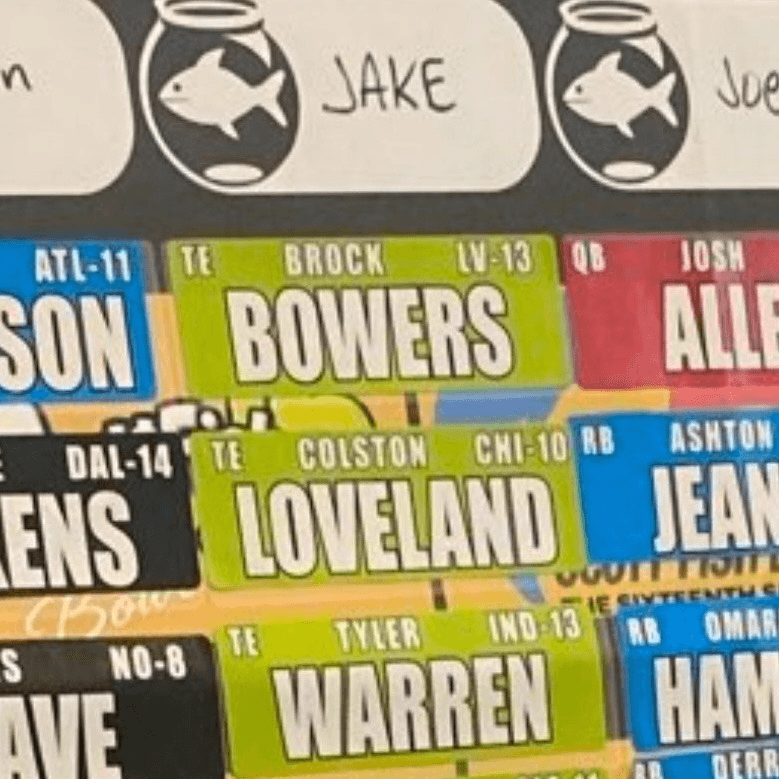
It wasn’t just my fellow drafters. There were several drafts happening simultaneously, and those folks started to get in on it, too. Hell, little kids were joining in on the fun. The mood had shifted. There was a certain goofy, jovial energy (possibly aided by the selection of beers on tap) filling the gymnasium. And I wanted to keep it going.
Unfortunately, the best available tight end was Harold Fannin Jr., who I like but don’t love. Especially so early in the draft. Could Fannin once again be the focal point of the Browns offense? Sure. But with a new coaching staff, some interesting additions to the receiving corps and a screaming question mark at quarterback, Fannin’s far from a slam dunk.
In isolation, I might’ve instead chosen Garrett Wilson, arguably the most underrated wide receiver on planet Earth. But I was surrounded by so much merriment; such wonderful goofball vibes. That atmosphere is exactly why I fell in love with fantasy football in the first place.
So on my walk up to the draft board, I grabbed the red sticker sheet (full of quarterback nametags) and turned to face the crowd like a pro wrestling villain, exaggeratingly pointing to the list in my hand. They erupted into a chorus of boos. Then I grabbed the green sticker sheet full of tight ends and hoisted it triumphantly over my head. They roared with approval and applause.
“Green! Green! Green!”
The people had decided. It was to be Fannin. I was committed to The Bit.
But It’s Also a Charitable Act
The question of practicality was starting to rear its ugly head, though. Drafting four quality tight ends was a unique and potentially fruitful methodology. But what happens when there’s a steep dropoff at the position? At what point does picking another tight end start to set my team back?
I’d already watched Tucker Kraft slip through my fingers, snatched up shortly after I selected Warren in the third round. With Trey McBride also long gone, we were entering murkier territory.
I was considering abandoning The Bit, or at least putting it on pause for a round or two. But then one of my fellow drafters had a spark of brilliance. I could draft yet another tight end … but only on the condition that someone make a small donation to Fantasy Cares—the nonprofit organization behind the Scott Fish Bowl—first.
Much to my surprise (and delight), in a matter of seconds someone presented a receipt of their donation. In fact, it happened so quickly that I increased the donation amount required for my next tight end pick. And once again, a generous tight end enthusiast quickly showed proof of their charitable contribution. The Bit wasn’t just a bit anymore. It was a chance to do some real good.
I didn’t always love my selections, and watching other drafters slap names like George Kittle up on the board started to hurt my soul more than I thought possible. This was still a competitive draft, after all. No one was going to just LET me have my favorite tight ends. But in no other situation would my drafting Travis Kelce in the Round 5 or Mark Andrews in Round 6 elicit such delight among so many people. And at the same time, dollars were flowing toward an incredible cause. That’s a win-win.
By the time the “live” draft portion of the event had wrapped up (the first half is done in person and the back half is done online with an 8-hour clock), folks had donated enough money to keep me active in the tight end pool through Round 12.
And I gotta say, it became pretty freeing. It let me snatch up all my favorite sleepers (Isaiah Likely, Chig Okonkwo, Greg Dulcich) without overthinking. I felt comfortable nabbing some “safer” tight ends I’d normally overlook (Jake Ferguson, Hunter Henry).
The following day, as I was nearing my first pick not yet backed by a donation, I half expected The Bit to fizzle out. But a social media post explaining the situation quickly ensured that my tight end trend would continue through the end of the draft. Because one generous soul, who wasn’t even in attendance to see The Bit turn into a communal act of charity, contributed enough money to keep those good vibes rolling.
Deep sleepers like David Njoku and AJ Barner begat super deep sleepers like Eli Stowers and Terrance Ferguson, which begat near-comatose sleepers like Erick All and Justin Joly. When it was all said and done, there was a lotta green on my board.
And lest you think I’ll abandon this strategy once the waiver wire opens…don’t worry. Someone also donated to ensure my first few waiver pickups are ALSO tight ends.
But Is It Worth It?
Behold:
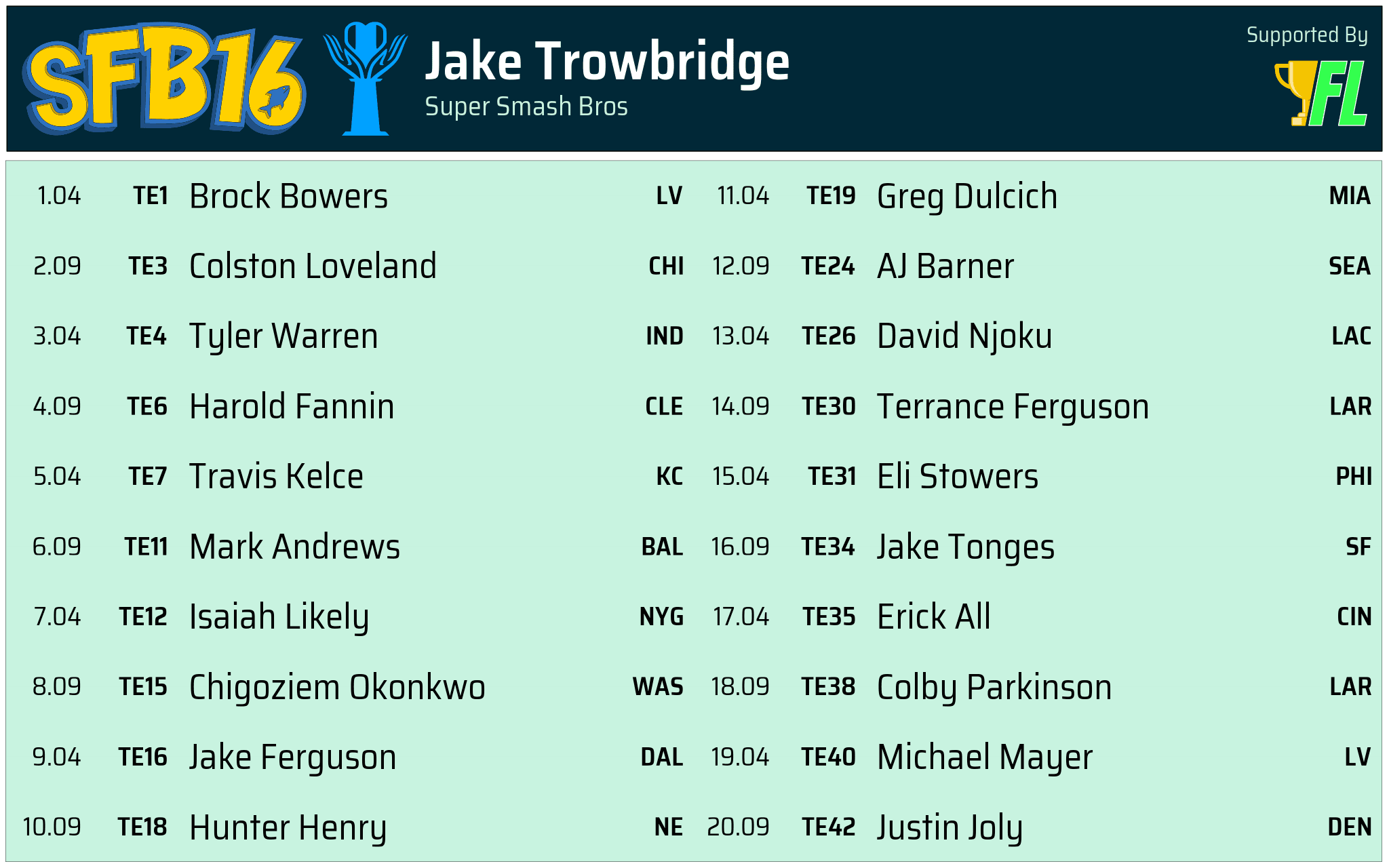
Isn’t that one of the most beautiful things you’ve ever seen? I feel like I now understand what it’s like to be a parent.
You might be wondering if I have any post-draft regrets about my strategy. And I actually do. Not about committing to The Bit, but about some of the specific tight ends I chose. Although Warren was the practical choice in Round 3, my heart wanted Tucker Kraft. And I should’ve known there was no way in hell he’d make it to the fourth round … in a draft held in Wisconsin.
I also wish I’d taken Kittle over Kelce in the fifth. I know Kittle has injury concerns, but for however many games he plays, he’ll be a big play waiting to explode. Grabbing Jake Tonges as a pseudo-handcuff just doesn’t spark the same type of joy.
I also missed out on Brenton Strange by taking Dulcich earlier than was probably necessary. But I gotta have my Dulcich! If this guy can finally avoid injuries, he could easily lead the Dolphins in targets.
But of course, none of that really matters.
Look, I know the odds of me winning this gigantic tournament with a roster stuffed with more tight ends than a BBL clinic are slim. Maybe even nonexistent. But this tournament isn’t really about that. Heck, fantasy football isn’t even about that when you dig below the surface.
It’s about socializing with people who have a shared interest in this wonderfully stupid game. It’s about making friends. It’s about building a little community. So, if I can play my dumb little part in directing some extra cash toward a wonderful cause and foster a little communal spirit in the process (even if it’s just a bunch of tipsy drafters shouting the word “GREEN” at me)?
Well damn. I’ve already won.
Note: Fantasy Cares is still accepting donations. You can learn more about the organization here. And if you feel moved by the spirit of The Bit or just want to help spread a little joy, please consider donating.
Join Our Newsletter
Trusted by 400,000+ fantasy football players. Get access to Fantasy Life's free award winning newsletter and tools, all in one step.
By registering or logging in, you agree to our Terms of Use and Privacy Policy.
Players Mentioned in this Article






Published Updated